GEN 3.3 AIR TRAFFIC SERVICES
1
Responsible Service
The authority responsible for the overall administration of air traffic services provided for both domestic and international civil aviation is the Ministry of Land, Infrastructure and Transport, Office of Civil Aviation.
Office of Civil Aviation
Ministry of Land, Infrastructure and Transport
11, Doum 6-ro, Sejong-si, 30103 Republic of Korea
TEL : +82-44-201-4304
Telefax : +82-44-201-5631
AFS : RKSLYAYX
Website : http://www.molit.go.kr
2 Area of responsibility
3 Type of services
The following types of services are provided :
-
Area control
-
Approach control
-
Aerodrome control
-
Flight information service and Alert service
4 Co-ordination Between the Operator and ATS
Co-ordination between operator and ATS is affected in accordance with ICAO Annex 11, Chapter 2.15.
5 Minimum Flight Altitude
-
Except in the case where the aircraft takes off or lands, no aircraft shall make a flight below it as prescribed by the Ordinance of the Ministry of Land, Infrastructure and Transport. This provision shall not apply in the case where the Minister of Land, Infrastructure and Transport permits it and where the aircraft flies for any emergency operation for search, rescue, etc. of persons, etc. due to accident, disaster or other mischance of the aircraft(Aviation Safety Act, Article 68 and Article 69, para 1).
-
Pursuant to Article 68 of Aviation Safety Act, an altitude at which aircraft is prohibited from flying below it (hereinafter referred to as the "minimum safe altitude") shall be one of the following items (Enforcement Regulation of Aviation Safety Act, Article 199).
(1) For aircraft engaged in visual flight rules, higher of either the altitude at which the aircraft shall not endanger people or goods on land or water when the power-equipment stop during flight and land safely or one of the following altitudes.
-
Altitude of 300 meter (1 000 ft) above the top of the tallest obstacle in a 600 meter radius of the aircraft concerned in the sky above the areas where people or building structures are densely concentrated.
-
Altitude of 150 meter (500 ft) above the top of people or structures on land or water surface in sky above the areas where people and building structures are not densely concentrated and the areas of wide water surfaces.
-
Altitude of 150 meter (500 ft) above land or water surface in areas other than as referred to in items (a) and (b).
(2) Altitude determined by the Minister of Land, Infrastructure and Transport for the aircraft engaged in instrument flight rules.
-
-
Any person who wishes to fly below the minimum flight altitude under the Article 68 of the Aviation Safety Act, shall submit the Application for Flight Approval with each of the following items recorded to the Administrator of Regional Office of Aviation and get the approval(Enforcement Regulation of Aviation Safety Act, Article 199) :
-
Name and address
-
Aircraft type, nationality and registration mark
-
Summary of flight plan (purpose, date and time, course, and altitude shall be recorded)
-
Reason for flying below the minimum flight altitude
-
Names and qualification of pilots
-
Names of accompanying persons and purpose of accompaniment
-
Other items that may be useful
-
-
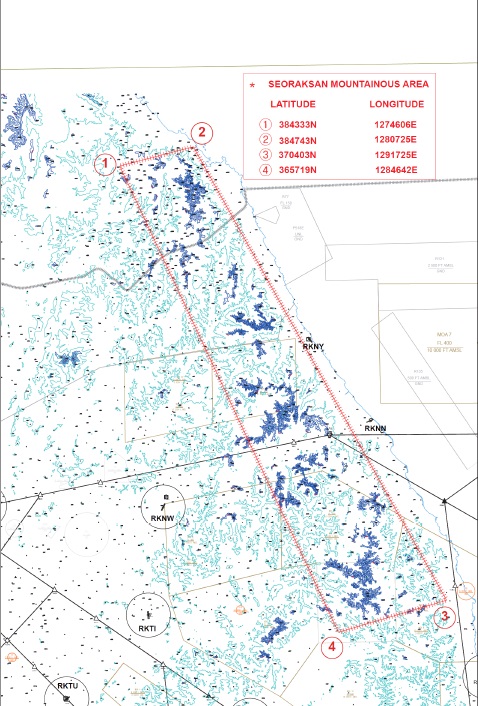
SEORAKSAN area : the area bounded by the line beginning at 384333N 1274606E, to 384743N 1280725E, to 370403N 1291725E, to 365719N 1284642E, thence to point of beginning. The minimum obstacle clearance (MOC) over mountains with heights at or above 1 200 m within this area shall be 600 m(2 000 ft).
-
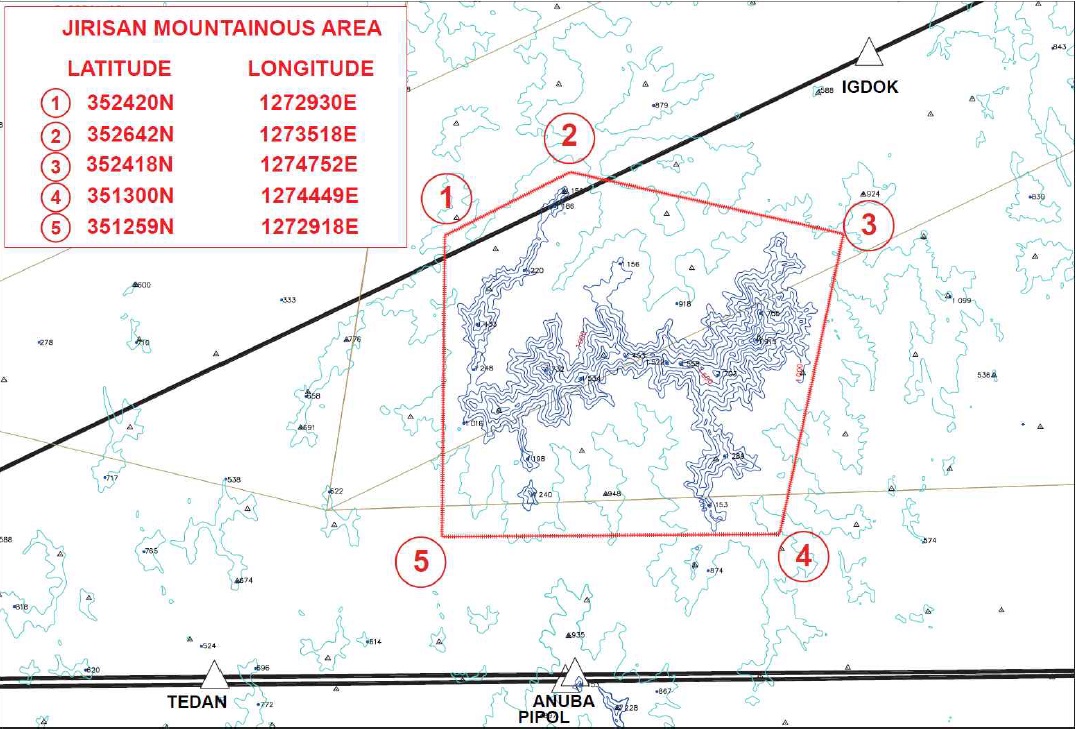
JIRISAN area : the area bounded by the line beginning at 352420N 1272930E, to 352642N 1273518E, to 352418N 1274752E, to 351300N 1274449E, to 351259N 1272918E, thence to point of beginning. The minimum obstacle clearance(MOC) over mountains with heights at or above 1 000 m within this area shall be 600 m(2 000 ft).
-
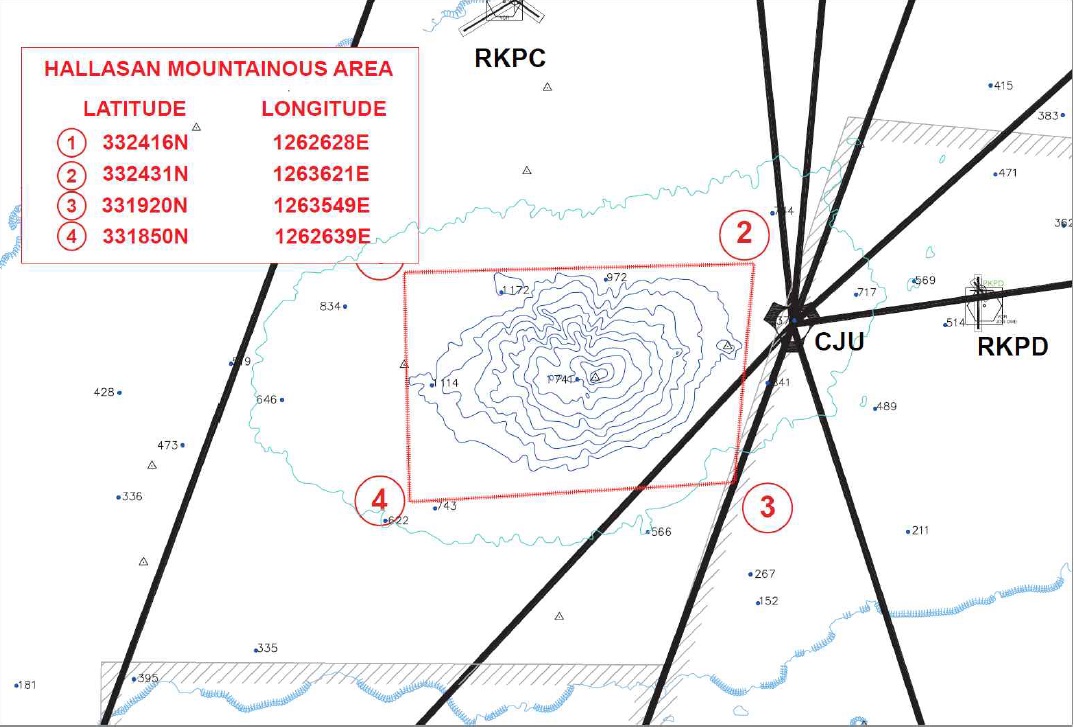
HALLASAN area : the area bounded by the line beginning at 332416N 1262628E, to 332431N 1263621E, to 331920N 1263549E, to 331850N 1262639E, thence to point of beginning. The minimum obstacle clearance(MOC) over mountains with heights at or above 1 000 m within this area shall be 600 m (2 000 ft).
-
SEORAKSAN area : See the page GEN 3.3-4
-
JIRISAN area : See the page GEN 3.3-5
-
HALLASAN area : See the page GEN 3.3-5
SEORAKSAN MOUNTAINOUS AREA
JIRISAN MOUNTAINOUS AREA
HALLASAN MOUNTAINOUS AREA
6 ATS Units Address List
|
Name |
Postal Address |
Tel NR |
Telefax NR |
AFS |
|
Air Traffic Management Office (Daegu ACC/FIC) |
50-12, Maeyeo-ro 1gil, Dong-gu, Daegu (Sang Mae Dong) 41059, Repubilc of Korea |
+82-53-668-0244 |
+82-53-668-0276 |
RKDAZQZX |
|
Incheon Air Traffic Control Regional Office (ACC) |
P.O Box 26, Incheon Airport Post Office 272, Gonghang-ro, Jung-gu, Incheon 22382 Republic of Korea |
+82-32-880-0288 |
+82-32-889-2381 |
RKRRZQZX |
|
Seoul APP |
Seoul Regional Office of Aviation, 47, Gonghang-ro, 424 Beon-gil, Jung-gu, Incheon 22382 Republic of Korea |
+82-32-740-2561~2 |
+82-32-740-2259 |
RKSIZAZX |
|
Gimhae APP |
Busan Regional Office of Aviation, 108, Gonghangjinip-ro, Gangseo-gu Busan 46723 Republic of Korea |
+82-51-974-2291~2 |
+82-51-974-2250 |
RKPKZAZX |
|
Jeju APP |
Jeju Regional Office of Aviation, 2, Gonghang-ro, Jeju-si, Jeju Special-Governing Province 63115 Republic of Korea |
+82-64-797-1680~2 |
+82-64-797-1683 |
RKPCZAZX |
|
Details of other ATS Units contact numbers and addresses appear in the AD and ENR sections. | ||||
-
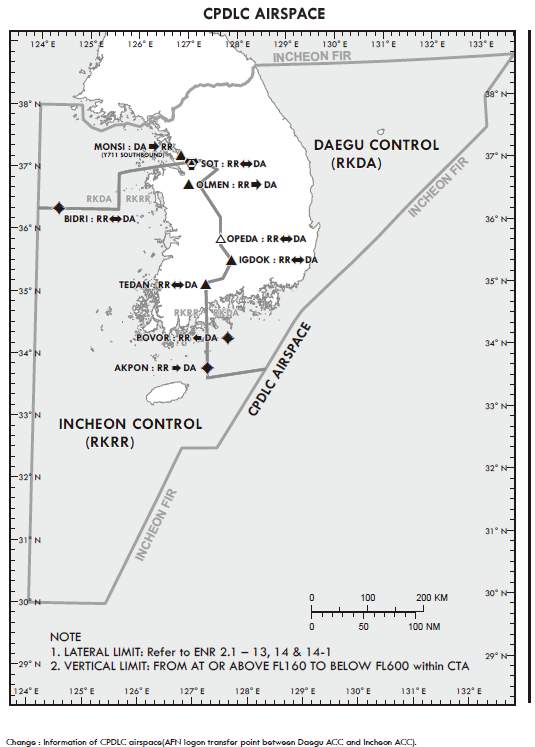
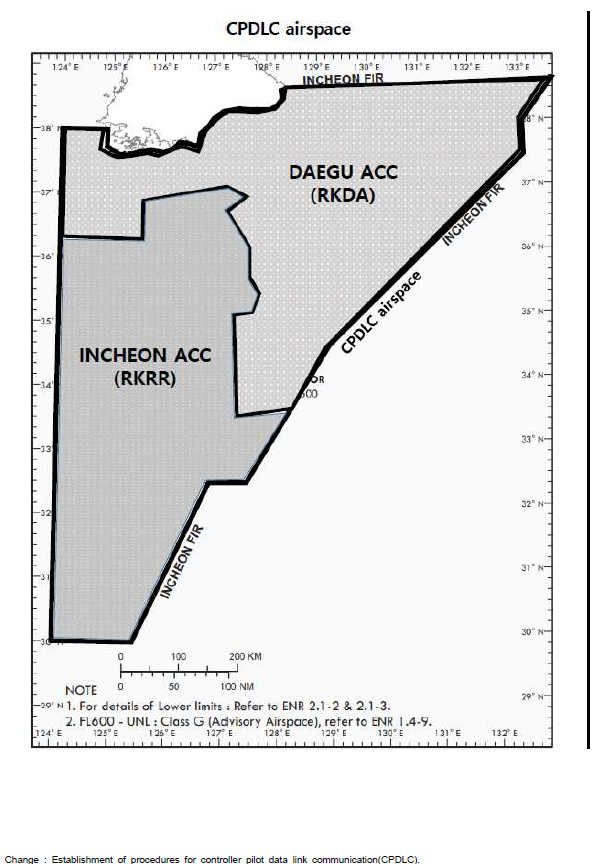
ATS data link service via CPDLC within Incheon FIR shall be provided by Daegu Area Control Center(ACC) and Incheon Area Control Center(ACC).
-
Voice remains the primary and controlling air/ground communication means.
-
Voice communication should be used in non-routine situations, such as those requiring expeditious execution, correction of erroneous clearances, or clarification of ambiguous ATC instructions.
-
Daegu?Incheon ACC provide CPDLC services for selected ATC messages that relatively less time-critical.
Daegu·Incheon ACC provide CPDLC services for selected ATC messages that relatively less time-critical.
-
SSR code assignment and identification
-
Direct flight instructions
-
Holding clearance
-
Frequency change
* Refer to 7.1.3 for details on operational message.
-
-
In Incheon FIR, equipage and operation of CPDLC is not mandatory. Aircraft operator must obtain the appropriate approval from the states of registry or state of operator.
-
CPDLC service is provided for FANS-1/A equipped aircraft using VHF data link and satellite data link.
-
The operation time of CPDLC is 1500-1859 UTC everyday.
CPDLC is provided to aircraft operating within the Daegu · Incheon ACC area of responsibility where VHF voice communication and surveillance services are provided, at or above FL 160 and below FL 600, within the Incheon Flight Information Region(FIR).
The following CPDLC operational message are used by Daegu ACC and Incheon ACC when providing ATS data link service.
-
Uplink messages(Controller→Pilot)
[SSR code assignment and identification]
ADVU-9 SQUAWK (SSR code)
ADVU-15 SQUAWK IDENT
[Direct flight instructions]
RTEU-2 PROCEED DIRECT TO (positioin)
RTEU-4 AT (position) PROCEED DIRECT TO (position)
[Holding clearance]
RTEU-12 AT (position) HOLD AS PUBLISHED
[Frequency change]
COMU-1 CONTACT (unit name) (frequency)
COMU-8 CHECK STUCK MICROPHONE
-
Downlink messages(Pilot→Controller)
RSPD-1 WILCO
RSPD-4 ROGER
In order to receive ATS services using CPDLC, the following information shall be included in the flight plan.
-
The aircraft’s callsign shall be entered in the flight plan exactly as it is used for CPDLC logon.
-
In item 18, the aircraft’s registration number shall be specified, matching actual aircraft registration.
-
The data link equipment capabilities shall be indicated in item 10, using the appropriate letters “J3, J4, J5, J7”.
The ATS Facility Notification(AFN) logon is prerequisite to any CPDLC connection.
The flight identification to be used for the AFN logon shall be the same as that filed in the ATS flight plan.
The AFN logon address for Daegu ACC is “RKDA”, and for Incheon ACC is “RKRR”.
In case the aircraft enters airspace where the ATS data link services are provided from the airspace where such services are also provided, comply with the instructions of the controller responsible for the airspace in which flight is currently operating.
In case the aircraft enters airspace where the ATS data link services are provided from the airspace where the ATS data link services are not provided, the AFN logon shall be conducted as follows.
When entering from another FIR, it is recommended to logon 15 minutes prior to Incheon FIR boundary.
When departing from airport within Incheon FIR, it is recommended to logon before takeoff or by the time to enter CPDLC enabled airspace after takeoff.
* In case of depart from airport within Incheon FIR and logon before takeoff, connection will be established with Deagu/Incheon ACC 3-5 minutes before enter CPDLC enabled Daegu·Incheon ACC airspace.
The AFN logon transfer point between Daegu ACC and Incheon ACC is referenced in ‘GEN 3.3-10 CPDLC airspace’.
-
Communication between air traffic controller and pilot initiated via voice should be completed by voice.
-
Communication between air traffic controller and pilot initiated via CPDLC should be completed by CPDLC.
-
The downlink response “WILCO” indicates that the instruction is understood and will be complied by the pilot.
-
Pilot readback for ATS clearance/instruction issued via CPDLC is not required.
-
In case the pilot is unable to comply with an ATC instruction uplinked via CPDLC, the pilot shall close the message transaction by replying with "ROGER" or another appropriate downlink message, and request an alternative instruction via voice.
-
Free text message(downlink) shall not be used.
The termination of CPDLC connection shall be conducted by one of the methods as follows.
-
When exiting Incheon FIR, “CONTACT [ATC facility] [frequency]” message is uplinked before crossing the boundary. The pilot should acknowledge to this message by sending "WILCO". After this communication is completed, an “END SERVICE” message will be uplinked to terminate the CPDLC connection.
-
When a communication transfer instruction is given by voice, “END SERVICE” message will be uplinked to terminate the connection.
-
When CPDLC connection cannot be established successfully, the pilot shall disconnect CPDLC and then initiate another AFN logon. If the pilot continuously fails to establish CPDLC connection, the pilot shall inform the controller.
-
When the pilot recognizes a failure of CPDLC connection or abnormal operation, the pilot shall terminate CPDLC connection and inform the controller via VHF voice communication.
Example)
Pilot : CPDLC failure. Disconnect CPDLC. Continue on voice.
Controller : Roger. Continue on voice.
-
When the controller recognizes a failure of CPDLC connection or abnormal operation, the controller will instruct the pilot to terminate CPDLC connection.
Example)
Controller : CPDLC failure. Disconnect CPDLC. Continue on voice.
Pilot : Roger. Continue on voice.
-
When the controller wants CPDLC to be connected, the controller will instruct the pilot to initiate AFN logon via VHF voice communication.
Example)
Controller : Logon again to DAEGU Control(RKDA)/ INCHEON Control(RKRR).
Pilot : Roger.
-
In case of an extensive contingencies of CPDLC, the controller will inform the pilot via VHF voice communication.
Example)
Controller : All stations, CPDLC failure. (Instructions)
Controller : All stations, resume normal CPDLC operations.
-
If the controller or pilot has any doubt as to the intent of message, or if any other ambiguity exists, controller or pilot shall clarify the message via VHF voice communication.
-
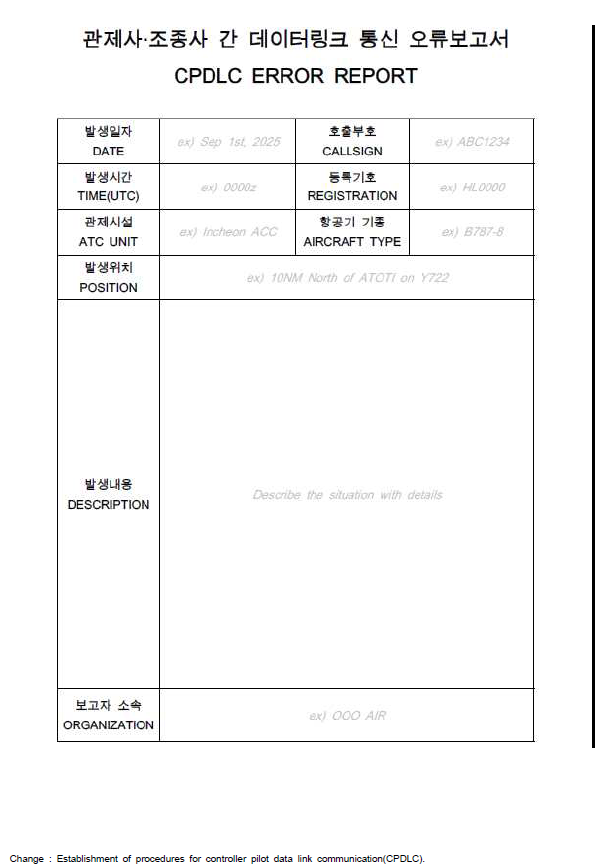
Pilots or operators who have encountered problems with ATS data link service within Incheon FIR shall report the problems using the attached form via email.
Daegu ACC(RKDA) : pheonix49@korea.kr
Incheon ACC(RKRR) : bagelmb@korea.kr